5 Signs Your Sermon Prep Process Is Broken, and How to Fix It
If Saturday night still finds you staring at a blank outline, the problem probably is not your discipline. It is your process.

Saturday night sermon prep is a running joke in pastor circles, right up until it stops being funny. Ask around and most pastors will admit, at least once, to finishing an outline while the coffee maker was already set for six the next morning. That happens to everyone occasionally. The problem is when it happens most weeks, and it starts to feel less like an emergency and more like the process itself.
Here is the harder truth: the issue is rarely discipline. Plenty of exhausted, faithful pastors sit down with every intention of getting ahead and still end up racing the clock by Saturday. What is usually broken is not the pastor. It is the system they are using, or the absence of one.
Below are five signs your sermon prep process needs an overhaul, along with a practical fix for each. None of these require more hours in the week. They require a different shape to the hours you already have.
This piece focuses specifically on the shape of your weekly process. For a broader look at reclaiming your calendar overall, see our companion piece, How Pastors Can Save 10 Hours Every Week .
Bryan Chapell's guide to the 'big idea' approach behind fix #3 below, with a sharper focus on Christ-centered application once the outline is built.
1. You start from a blank page every week
If your Monday morning begins with "what am I even going to preach on," the prep process has already lost before it started. A blank page every week means every sermon is competing with the tyranny of the immediate: whatever crisis, question, or headline is loudest that particular Monday.
Ezra did not work this way.
For Ezra had set his heart to study the Law of the LORD, and to do it and to teach his statutes and rules in Israel.Ezra 7:10
The fix is a running idea file, not a sermon calendar you build from scratch every quarter. Keep a single running document, note app, or notebook where you drop sermon ideas, verses that stop you mid-read, and questions from counseling conversations the moment they happen. By the time you sit down to plan a series, you are choosing from twenty live options instead of staring at nothing.
2. You cram five stages of work into one sitting
Exegesis, outlining, illustration, application, and manuscript writing are five different kinds of mental work. Most broken prep processes try to do all five in a single marathon sitting, usually late in the week, usually under pressure.
A process that only works when nothing else goes wrong is not a process. It is a hope.
The plans of the diligent lead surely to abundance, but everyone who is hasty comes only to poverty.Proverbs 21:5
The fix is separating those stages across separate days, even if each session is short. Exegesis on Tuesday. Outline on Wednesday. Illustrations and application on Thursday. A read-through or manuscript pass on Friday. Twenty focused minutes on four different days beats four rushed hours crammed into one.
3. You have no repeatable framework for building an outline
Some weeks the outline comes together in twenty minutes. Other weeks it takes four hours of staring at a blinking cursor, and you can never predict which week you are going to get. That inconsistency is usually a sign there is no actual method, just instinct, and instinct has bad days.
Write the vision; make it plain on tablets, so he may run who reads it.Habakkuk 2:2
A process that only works when nothing else goes wrong is not a process. It is a hope.
The fix is adopting one repeatable framework, such as the "big idea" method (what does the text say, what does it mean, what does it matter), and running every text through the same set of questions. A framework will not make every sermon brilliant, but it will make every week predictable, which is what actually protects Saturday nights.
4. Illustrations and application feel bolted on
If your best illustrations always seem to arrive at 11 p.m. the night before, in a slight panic, that is not a gift for spontaneous insight. It is a symptom of exegesis happening in isolation from the rest of your week, rather than alongside it.
The fix is collecting illustrations as they happen, not hunting for them after the outline is done. Keep a running list of stories from hospital visits, staff meetings, your own reading, and your own family life, tagged loosely by theme (grace, suffering, perseverance, money). When application time comes, you are choosing from real material instead of manufacturing an anecdote under deadline.
5. You have no record of what you already preached
A surprising number of pastors have preached the same illustration twice in one year, or realized mid-series that they covered this exact passage eighteen months ago, because there is no system tracking what has already been said.
Do your best to present yourself to God as one approved, a worker who has no need to be ashamed, rightly handling the word of truth.2 Timothy 2:15
The fix is keeping a simple, searchable log: date, text, series, and a one-line summary, for every sermon preached. This is also where a tool built specifically for pastors earns its keep.
Sermoni gives pastors one place to plan series, track what has already been preached, and organize prep notes without juggling three different apps. CP Mag covered the platform in depth in our Sermoni feature.
Read our full feature: Sermoni Wants to Give Pastors Their Saturdays Back .
Building a Process You Can Trust
None of these five fixes require a personality change. They require treating sermon prep as a weekly system with defined stages, rather than a single high-stakes event that happens whenever the calendar finally forces it. The goal is not a perfect sermon every week. It is a sustainable rhythm that still produces a faithful, well-built sermon even on the weeks that go sideways, because a sermon prep process that depends on nothing going wrong will eventually meet a week where everything does.
Key Takeaways
- A blank page every week means no system for capturing ideas, verses, and questions as they happen.
- Cramming exegesis, outlining, illustration, and writing into one sitting produces avoidable stress and uneven results.
- A repeatable framework, like the "big idea" method, makes sermon quality less dependent on how the week is going.
- Illustrations and application should be collected throughout the week, not hunted for the night before.
- A simple log of what has already been preached prevents repeats and saves real planning time.
Questions for Reflection
- Which of these five signs hit closest to home this week?
- What would it look like to spread your prep work across four shorter sessions instead of one long one?
- Where could you start keeping a running file of sermon ideas, and what would you do with the first entry?
- Do you have any record of what you preached last year? What would it change if you did?
- What is one small process change you could try for just the next four weeks?
Christianpreneur Magazine may earn a commission from qualifying purchases made through Amazon affiliate links at no additional cost to the reader.
More in Pastors
See all
Pastor of the Month: Rich Villodas of New Life Fellowship
The Brooklyn-born lead pastor of New Life Fellowship is helping churches rediscover a slower, deeper, more emotionally healthy way to follow Jesus.
Marcus Reed · 7 min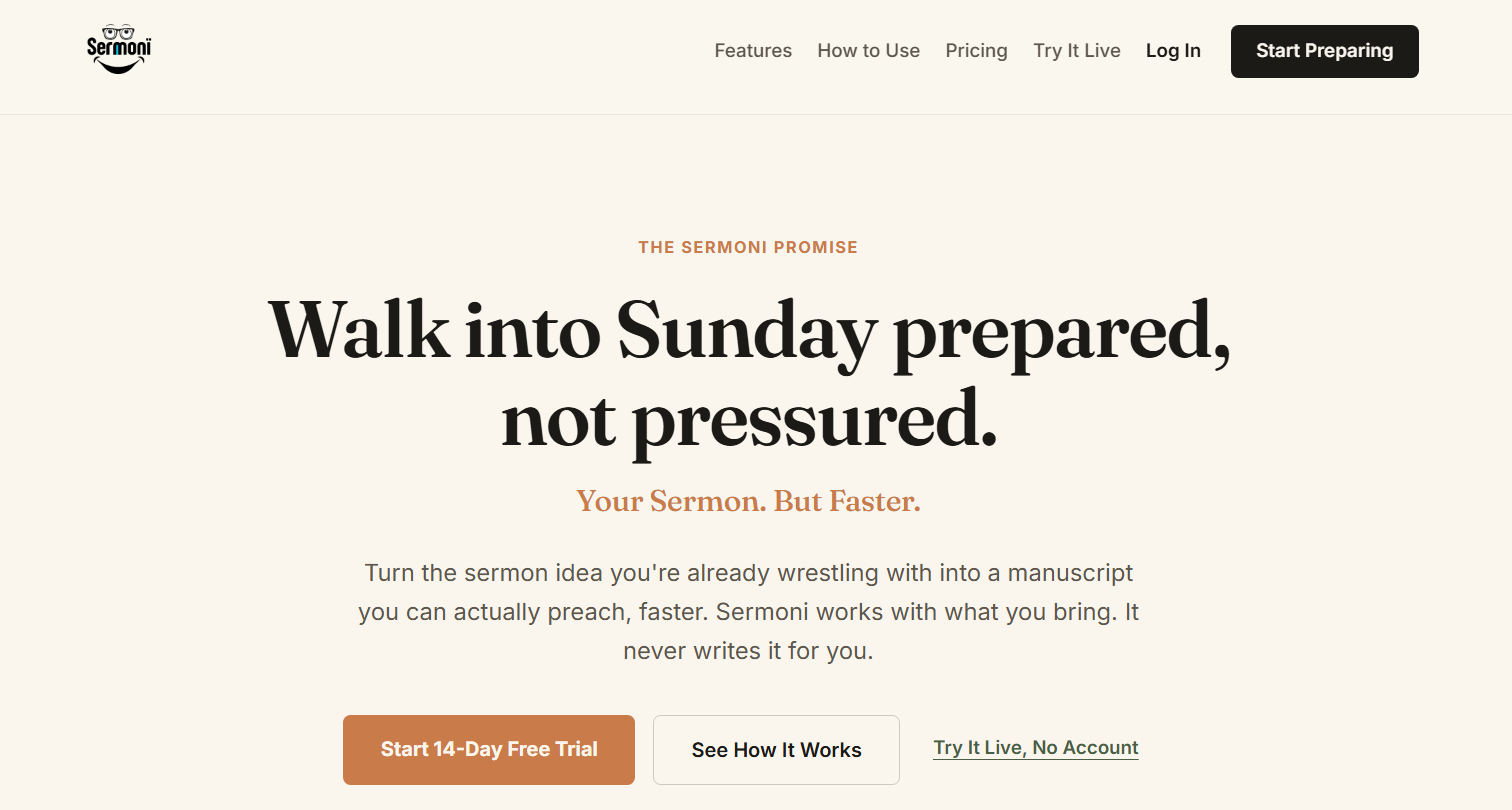
Sermoni Wants to Give Pastors Their Saturdays Back
The new ministry preparation assistant helps pastors turn prayer, study, and emerging sermon ideas into organized, preach-ready messages without handing the pulpit over to technology.
Michael Reynolds · 12 min
How Pastors Can Save 10 Hours Every Week Without Sacrificing Biblical Integrity
Ministry Was Never Meant to Be a Race Against the Clock.
Michael Reynolds · 6 min